Lotus Eletre X: 952 HP and a complicated relationship with the scales | CarDynamics
Cars·Electric·News
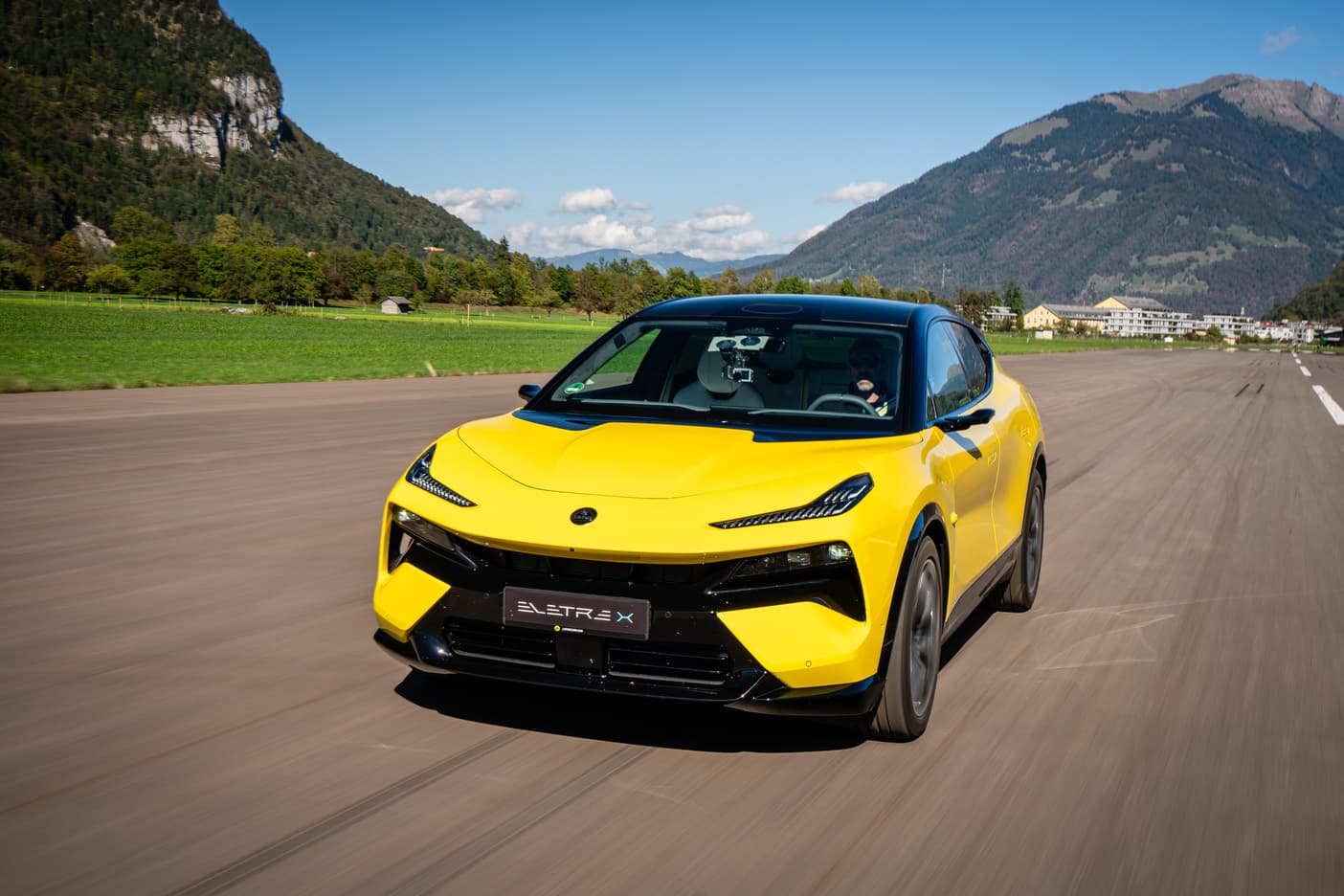
Lotus Eletre X: 952 HP and a complicated relationship with the scales
The H1000, the range-topping model, tips the scales at a hefty 2,615 kg — enough to suggest it might have a gravitational field of its own. Granted, it packs 952 hp, 935 Nm and a 0–100 km/h time of 3.3 seconds. Lotus even claims 3.5 seconds with just 10% battery charge remaining. Impressive, but..
Lorenzo Pollini· October 29, 2026
1 / 8
Colin Chapman, Lotus founder, had a simple rule: “Simplify, then add lightness.” The Eletre X must have heard it mentioned down at the pub, just before ordering another portion of pulled pork and a few pints of dark beer.
The H1000, the range-topping model, tips the scales at a hefty 2,615 kg — enough to suggest it might have a gravitational field of its own. Granted, it comes armed with 952 hp, 935 Nm and a 0–100 km/h time of 3.3 seconds. Lotus even claims it can manage 3.5 seconds with just 10% battery charge remaining. Impressive. But that doesn't change the fact that every kilo still has to be braked, steered and persuaded to change direction. Physics — famously devoid of a sense of humour — always gets the final word.
And yet, beneath this mountain of metal and batteries lies an interesting attempt to resolve a contradiction. If shedding weight isn't enough, perhaps the next best thing is to make it less of a liability. Enter X-Hybrid, a technology that turns the traditional hybrid formula on its head: rather than an electric motor stepping in to assist a petrol engine, it's an electric car carrying a combustion engine around with it, so it doesn't have to rely entirely on a charging socket.
Under the bodywork sits a 70 kWh NMC battery, using a chemistry that combines nickel, manganese and cobalt to achieve
high energy density
, storing a substantial amount of energy relative to the battery pack's mass and volume. The system operates at
900 V
and, through its power electronics, feeds
two permanent-magnet electric motors
: a
310 kW
unit at the front and a
390 kW
unit at the rear in the H1000 configuration. The transmission is
single-speed
, and drive is sent to all four wheels. No gear changes to worry about: torque arrives instantly, while the electronics decide how best to distribute it.
Things get interesting when the battery can no longer do all the heavy lifting on its own. The 2.0-litre turbocharged four-cylinder engine isn't primarily there to drive the wheels, but to power a 150 kW generator, producing electricity on the move and recharging the battery. This is series-hybrid operation: the combustion engine feeds the electric powertrain, while the electric motors provide the drive at the wheels. In other words, you don't have to wait for braking to recover energy: you can generate it while driving, too. By burning petrol, naturally, but with the engine running at its optimum operating point.
Above 85 km/h, under certain conditions, the system can switch strategies. The combustion engine connects mechanically to the front wheels and contributes directly to propulsion alongside the two electric motors. This is parallel-hybrid operation: at sustained speeds, sending some of the engine's power directly to the wheels can avoid some of the losses associated with energy conversion. The control unit decides how to combine the two strategies according to speed, battery charge and driver demand.
Lotus claims an electric range of up to 305 km and a total range of 1,200 km, helped by a 52-litre fuel tank. DC fast charging can reach 436 kW; according to the company from Hethel, charging from 20 to 80% takes around nine minutes. Ambitious figures, making the Eletre X a car designed to cover ground quickly without turning every journey into a hunt for a charging station. But range solves the problem of distance, not that of mass.
This is where the chassis comes into play. On the H1000, dual-chamber air suspension works alongside twin-valve adaptive dampers and a 48 V active anti-roll system, which Lotus says can deliver up to 1,400 Nm of stabilising torque — and goodness knows it needs it. Up front, there are six-piston Brembo brakes with 412 mm discs; at the rear, an active rear spoiler can generate aerodynamic load under braking, rather like a dragster's parachute. Lotus also claims to have cut weight by up to 120 kg compared with the Eletre 900. A respectable achievement, but given the numbers involved, it's a bit like announcing plans to empty the ocean with a teaspoon.
The real question, then, isn't how quickly the Eletre X accelerates. With figures like these, a straight road is a formality. The real question is how well it can disguise its sheer bulk when the road stops running straight, when it has to change direction, brake repeatedly and put the chassis to the test. Lotus maintains that it has preserved its dynamic DNA through electronics, suspension and body control. Perhaps. But however impressive the specification sheet may be, it cannot recreate the sensation of being behind the wheel.
Would Chapman have approved? Impossible to know. The Eletre X has taken on an extreme challenge: to reinterpret Lotus history in an era when power, range and technology seem to matter more than lightness. On the question of weight, though, the scales have already delivered their verdict.
 1 / 8